

Balen Shah came to power with a full majority. He joined the party through which he secured power only shortly before this year's elections. Unlike leaders who emerged from political movements, Shah did not rise through an established political struggle. He went from being a rapper to Kathmandu's mayor and eventually Nepal's prime minister.
The rise of the Rastriya Swatantra Party (RSP) in Nepal's political landscape has been extraordinary. The party was established in June 2022 and won 21 seats in the House of Representatives in its first national election, held in November of the same year.
Balen Shah himself entered electoral politics as an independent candidate and was elected Mayor of Kathmandu in May 2022. In the elections held on March 5 this year, the RSP won 182 of the 275 seats in the House of Representatives. Of these, 125 seats were secured through direct elections and 57 through proportional representation.
Balen Shah was an unfamiliar political figure for India. After he became prime minister, India immediately invited him to visit the country, but he did not respond with much enthusiasm. India's ambassador to Nepal traditionally meets newly appointed prime ministers to congratulate them. However, the then Indian Ambassador, Naveen Srivastava, could not do so. Reports in the Nepali media suggested that Balen Shah would not meet diplomats directly.
During the governments led by the Nepali Congress, CPN-UML and Maoist parties, prime ministers would often meet foreign ambassadors within hours of assuming office. Balen Shah, however, broke with this established practice.
How does Deep Kumar Upadhyay, a former Nepali Ambassador to India, view Balen Shah's visit compared with those of previous prime ministers?
Upadhyay says it is difficult to make definitive assessments about Balen Shah.
"Look, it is not easy to say anything with certainty about Balen Shah. He does not speak to the press, does not say much in Parliament and does not even meet his ministers very often. In such circumstances, any assessment of what he thinks about foreign policy can only be based on assumptions," Upadhyay says.
He points out that Balen Shah won the election under a new political party and does not face the ideological compulsions associated with communist parties to oppose India and the West.
"Balen has won the election through a new party. Unlike the communists, he has no ideological compulsion to oppose India and the West. His government has a full majority, and public confidence in it remains intact. In such circumstances, India will also have to engage directly with this government. India will not have the option available under a coalition government, where if discussions with the prime minister do not work out, it can approach the party supporting the government," Upadhyay says.
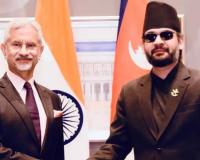
Anil Giri, a senior journalist with Nepal's leading English-language newspaper, The Kathmandu Post, travelled to India to cover Balen Shah's visit. According to Giri, previous Nepali prime ministers would themselves travel to New Delhi after taking charge, whereas Shah arrived following an invitation. He considers this the principal difference.
Giri says India has no prior experience of working with Balen Shah or the RSP. Earlier, RSP chief Rabi Lamichhane visited India and received an unexpectedly warm welcome at the BJP headquarters. Balen Shah's visit followed that engagement.
"Balen Shah was not in any hurry to visit India like other prime ministers. He took sufficient time before deciding to come," Giri says.
He adds that Shah did not come to power through an ideological movement. Unlike Nepal's communist parties, he may not have any ideological sympathy towards China, but he faces pressure to deliver on his promises.
Giri also argues that India's own policies have contributed to strengthening China's position and the roots of communist parties in Nepal.
"I believe India itself has strengthened China's roots and those of communist parties in Nepal. India imposed a blockade in 2015, which proved to be a tragedy for ordinary people. As a result, people in Nepal began looking towards China, while communist parties got an opportunity to promote anti-India Nepali nationalism. India cannot expect Nepal to meet every expectation. It must also think about these issues with sensitivity," he says.
Lokraj Baral, a prominent Nepali diplomat and author, believes that establishing coordination with Balen Shah will not be easy for India.
Baral says Shah meets his ministers only during Cabinet meetings and maintains no contact with the press. According to him, no democratic institution is functioning effectively, and power remains concentrated in Balen Shah's hands. In such a situation, much depends on his mood.
"However, I think Balen must have understood Nepal's real situation over the past eight months. India has announced an economic package worth $1.6 billion for Nepal, but the more important question is how much of it Nepal will actually be able to utilise," Baral says.
An editor from Nepal who travelled to India to cover the prime minister's visit, speaking on condition of anonymity, said Balen Shah deliberately kept the trip very short.
He said India wanted a three-day visit, but Balen arrived on the evening of November 22 and returned on the evening of November 23. Nepali prime ministers generally undertake three-day visits to India. Traditionally, they also meet members of civil society and visit some prominent places.
However, Balen kept the entire visit restricted and short.
"He wants to maintain an air of mystery so that speculation and curiosity continue. In this respect, too, Balen's visit was different from those of other prime ministers," the editor said.
Despite receiving a massive electoral mandate, Balen Shah has attempted to introduce laws through ordinances. Changes were made to the decision-making process of the Constitutional Council in such a way that the prime minister was given the final authority to select a new Chief Justice. The council is responsible for recommending appointments to state institutions. The move raised concerns about the executive gaining control over the judiciary.
Similarly, under another ordinance, the government removed 1,500 senior civil servants without preparing a plan to appoint replacements. This affected important functions, including the regulation of civil aviation and the conduct of school-level examinations.
Earlier, according to a report published by the Nepali media outlet The Kathmandu Post, the 36-year-old Nepali prime minister had refused to meet Indian Foreign Secretary Vikram Misri. Following Shah's refusal, Misri had to cancel his visit to Nepal.
Interestingly, Shah had initially accepted Prime Minister Narendra Modi's invitation. He also refused to meet senior officials from China and the United States, leaving Nepal's two other important partners displeased.
Earlier, in March, the new government began its tenure by arresting several political leaders on questionable legal grounds. Subsequently, the government demolished slum settlements along riverbanks without having any rehabilitation plan for the people living there.
Lokraj Baral says Balen Shah appears to believe that his government cannot make mistakes. After witnessing decades of misgovernance and corruption under previous political parties, people are currently willing to give him the benefit of the doubt. He acknowledges that this may be justified, but questions how long such public patience will last.
"He is distancing himself from sections that every government ultimately needs. These include the media, intellectuals, opposition parties and important foreign partners," Baral says.
Balen Shah's India visit has therefore highlighted more than a departure from Nepal's established diplomatic traditions. His limited engagement with political institutions, foreign partners and the media, alongside the concentration of decision-making power within his office, has raised important questions about the direction of his government and the future of Nepal's diplomatic relationships.
About The Author




Comment List